You saw this word. Or did you?
Fifteen words. Your memory. And an archive you can check.
Two inventories
Go one step at a time. If all steps are visible, cover the later ones with a sheet of paper.
1. The reading list
Read once, at your usual pace. Do not write the words down while the list is open.
bed · rest · awake · tired · dream
wake · snooze · blanket · doze · slumber
snore · nap · peace · yawn · drowsy
2. Your inventory
Without going back, write down the words you actually remember. If you have no paper, list them to yourself. Do not fill gaps with words that merely fit the theme.
Put a small dot beside your clearest recollection. Leave the first version alone for now: we want an inventory, not a perfect answer.
3. One specific question
Did the original list contain the word “sleep”?
Do not check yet. Choose what you remember now.
Your memory and the archive disagree
“Sleep” was not in the list. If you wrote it down before this question, the extra word was already in your first inventory. If you only chose “yes” now, we know only your answer to the recognition question. Those are different observations.
The original fifteen words:
bed · rest · awake · tired · dream · wake · snooze · blanket · doze · slumber · snore · nap · peace · yawn · drowsy
Compare your paper inventory with the archive. Mark omissions and additions separately: forgetting a word and adding one are different things. The dot beside a recollection records your confidence, but is not evidence of accuracy on its own.
On this point, you match the archive
Correct: “sleep” was absent. If you also left it out of your first inventory, this particular trap did not work for you. That does not make anyone’s memory infallible, just as an error here does not make it bad.
The original fifteen words:
bed · rest · awake · tired · dream · wake · snooze · blanket · doze · slumber · snore · nap · peace · yawn · drowsy
Compare your paper inventory with the archive. Mark omissions and additions separately: forgetting a word and adding one are different things. The dot beside a recollection records your confidence, but is not evidence of accuracy on its own.
The archive settles the question
“Sleep” was absent from the original list. An uncertain answer stays uncertain: we will not turn it into a mistake or attribute a memory to you that you never claimed.
The original fifteen words:
bed · rest · awake · tired · dream · wake · snooze · blanket · doze · slumber · snore · nap · peace · yawn · drowsy
Compare your paper inventory with the archive. Mark omissions and additions separately: forgetting a word and adding one are different things. The dot beside a recollection records your confidence, but is not evidence of accuracy on its own.
Why an extra word fits so well
The words lean towards one theme. The missing word neatly compresses it into a label. But “fits the meaning” and “was printed” are different claims.
In Henry Roediger and Kathleen McDermott’s 1995 experiments, participants sometimes recalled or recognized related words that had never been presented. This research procedure is known as the Deese–Roediger–McDermott, or DRM, paradigm.
A word-list task cannot establish that someone’s particular memory of a life event is false. Here we can check a small list against its preserved original. Outside this page, the conditions and evidence are different.
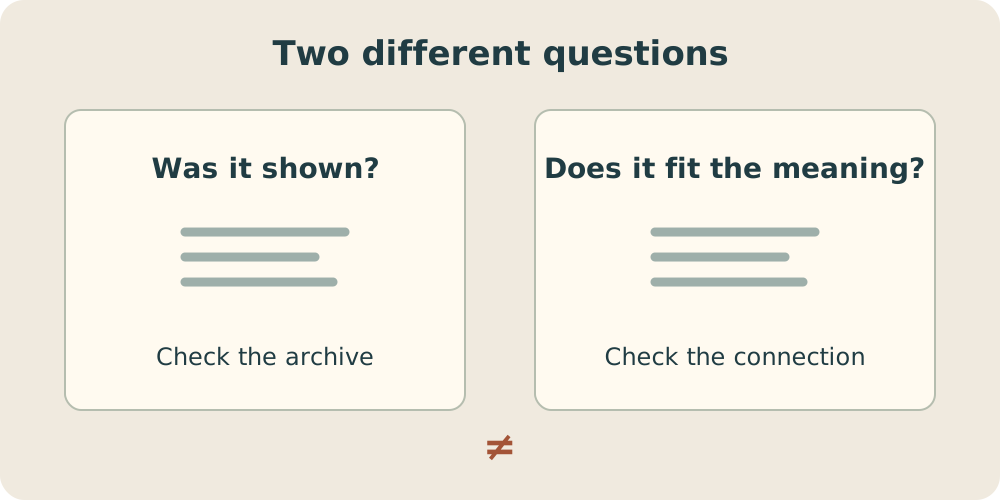
What you just tried
The English version uses a short, established list from this research tradition. The Russian version is our semantic adaptation, not a validated translation of a test. Some Russian words also resemble the absent word in their form.
We display the whole list at once, let you set the pace and hint at a catch in advance. Your result therefore cannot be compared with laboratory error rates. We do not score “memory strength”, collect your paper inventory or make a diagnosis. General visit measurement is described in the site settings.
Once you return to the start, you already know the answer. Repeating the task can help you inspect its design; it cannot demonstrate an improvement in your memory.
Keeping the meaning is not keeping the wording
The small trap is more interesting when the archive stays put. The question becomes what was actually shown, not how confidently someone remembers it.
If you share this page with a friend, do not name the absent word. Let their own inventory come first. Then compare two records, not two people: what was presented and what they recalled.